

Key Takeaways
- Automatic emergency braking is the single most consequential safety feature for preventing rear-end collisions.
- Many safety features are standard on base trims of newer vehicles but absent from older used models.
- Blind-spot monitoring and rear cross-traffic alerts are especially useful when driving with children on board.
- NHTSA and IIHS crash test ratings provide an independent measure of structural protection beyond feature lists.
- Lane-keeping assist varies widely in quality; understanding the difference between alert and assist matters.
Why safety features matter more on a budget
When a family is working with a tight ceiling, the temptation is to focus on price and monthly payment while treating safety features as a luxury tier. That calculation has a real cost. Crash avoidance technology has moved into affordable vehicle segments, and what a car does (or does not do) in the two seconds before impact can change outcomes significantly for rear-seat passengers, including children in car seats.
The list below is not about premium trim packages. It covers the features that have the clearest evidence of reducing crash frequency and severity, ranked by how much practical protection they offer families. Before you finalize any purchase, check whether a feature is standard on the trim you are considering or locked behind an upgrade. See our pre-purchase inspection checklist for guidance on verifying active systems on used vehicles.
Automatic emergency braking
Automatic emergency braking (AEB) detects an imminent forward collision and applies the brakes if the driver does not respond in time. The system does not prevent every crash, but it consistently reduces rear-end collision frequency and cuts impact speed when a crash does occur. Lower impact speed translates directly to reduced injury severity for rear-seat occupants.
AEB became a standard requirement on new vehicles sold in the US through a voluntary commitment by most major automakers, so most vehicles built after 2022 include it. On used vehicles, availability drops sharply for models older than 2016. When buying used, verify the feature is present and functioning, not just listed in a brochure for a different trim.
AEB reduces rear-end collision frequency and cuts impact speed even when it cannot prevent a crash entirely.
Blind-spot monitoring
Blind-spot monitoring (BSM) uses radar sensors to alert the driver when a vehicle is in an adjacent lane that mirrors and a quick head turn may miss. For families, lane changes on highway road trips with a distracted or overtired driver are a real scenario. A visual or audible warning in that moment costs nothing extra in a vehicle that includes it as standard.
Some systems pair BSM with rear cross-traffic alert, which warns you when a vehicle is approaching from the side while reversing. Parking lots are where a disproportionate share of low-speed impacts involving children occur. If a vehicle has only one of the two, rear cross-traffic alert is often more relevant to daily family use.
Rear cross-traffic alert is often more relevant to daily family use than blind-spot monitoring alone.
Rearview camera
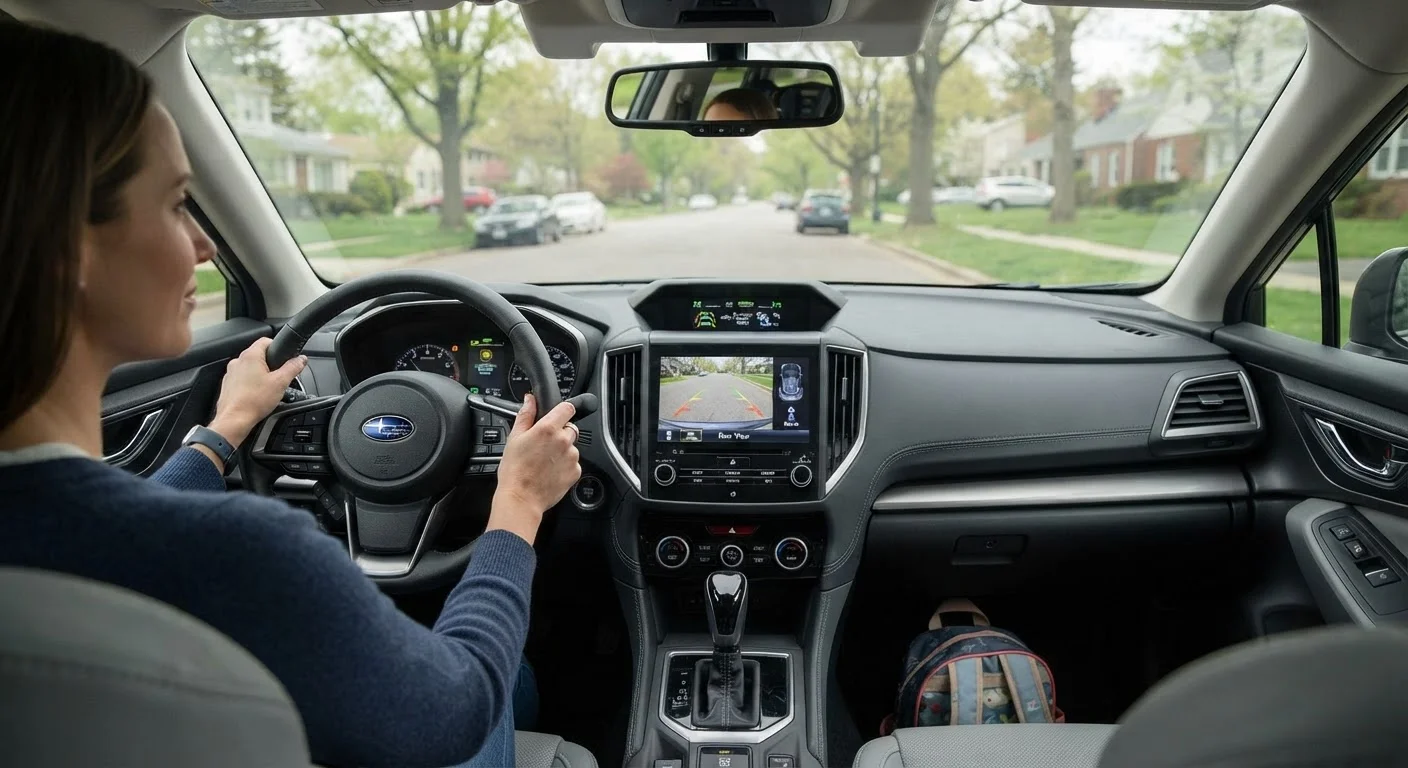
Federal rules have required rearview cameras on all new passenger vehicles sold in the US since May 2018, so any vehicle built for the 2019 model year or later will have one. On used vehicles older than that cutoff, check whether the feature was factory-installed or added as an aftermarket unit. Factory-integrated cameras connect to proper display screens and are calibrated to the vehicle; aftermarket installs vary considerably in quality and reliability.
A rearview camera does not replace checking surroundings before reversing, but it covers the area directly behind the vehicle that mirrors cannot reach. That zone is where small children are hardest to see from the driver's seat.
Any vehicle built for the 2019 model year or later is required by federal rule to have a rearview camera.
Lane-keeping technology
Two distinct features share a similar name here: lane departure warning (LDW) and lane-keeping assist (LKA). LDW alerts the driver when the vehicle drifts over a lane line without a turn signal. LKA goes a step further by applying steering input to bring the car back into the lane.
Quality varies. Some LKA systems are smooth and unobtrusive; others apply corrections abruptly and frustrate drivers enough that they turn the system off. If you are evaluating a vehicle, check owner forums or published reviews for notes on how that specific model's implementation behaves. A feature that gets disabled permanently is not providing protection.
A lane-keeping system that drivers turn off because it is irritating provides no real-world protection.
Structural ratings and side-impact protection
Active technology prevents crashes; vehicle structure determines what happens to occupants in crashes that occur anyway. IIHS side-impact test scores are worth checking, because side impacts carry a higher risk of serious injury than front impacts for the same impact energy. Updated IIHS side-impact protocols introduced in recent years use a heavier barrier to better replicate the force of being struck by an SUV or pickup truck.
Vehicles that score well under the updated test may not be the same models that scored well under the older, lighter test. Check the IIHS website for ratings under the current test version, not just an aggregate score that may reflect older methodology. This is especially relevant for families buying a sedan or compact car and frequently sharing roads with taller vehicles.
IIHS updated its side-impact test protocol to better reflect real-world collisions with SUVs and trucks.
LATCH anchor accessibility
LATCH (Lower Anchors and Tethers for Children) is a standardized system for attaching child safety seats without using the seat belt. Every passenger vehicle sold in the US since 2002 has LATCH anchors, but the ease of use varies significantly by vehicle. Anchors buried deep in tight seat bight gaps require more force and more awkward positioning to connect properly, which can lead to improper installation.
The NHTSA publishes ease-of-use ratings for child seat installation by vehicle and child seat combination. Check those ratings for the specific row where child seats will go, not just the front row. A vehicle that scores poorly on LATCH accessibility in the second row is a practical problem if that is where your children ride. See the ground-up buying guide for how to weave this check into your overall shopping process.
NHTSA ease-of-use ratings show how accessible LATCH anchors are in specific vehicle rows, not just whether they exist.
Putting it together before you buy
Safety ratings and feature lists are two different things. A car can earn strong NHTSA or IIHS scores based on its structure and passive restraints, while still lacking active prevention technology entirely. Look at both columns. IIHS publishes a list of vehicles that meet its Top Safety Pick criteria, and NHTSA provides star ratings by category on its website, both at no cost.
Check the trim level, not just the model
Many manufacturers list active safety features as standard on the model but apply that designation only to higher trim levels. On the base trim at the price point most budget shoppers are targeting, several features may be absent or available only as a paid package. Confirm the specific trim's standard equipment list before comparing vehicles, and verify the same for any used vehicle by looking up the original window sticker using the VIN through NHTSA's free online tool.
Safety features also affect what you pay for insurance, which is a line item that catches many families off guard. Our article on insurance costs families often underestimate explains how vehicle safety ratings factor into premium calculations. For a fuller picture of what a car will actually cost over time, the total cost of ownership breakdown covers fuel, depreciation, and maintenance alongside insurance.