
Vinyl, Laminate, and Hardwood Flooring: How Families Should Think About the Trade-offs

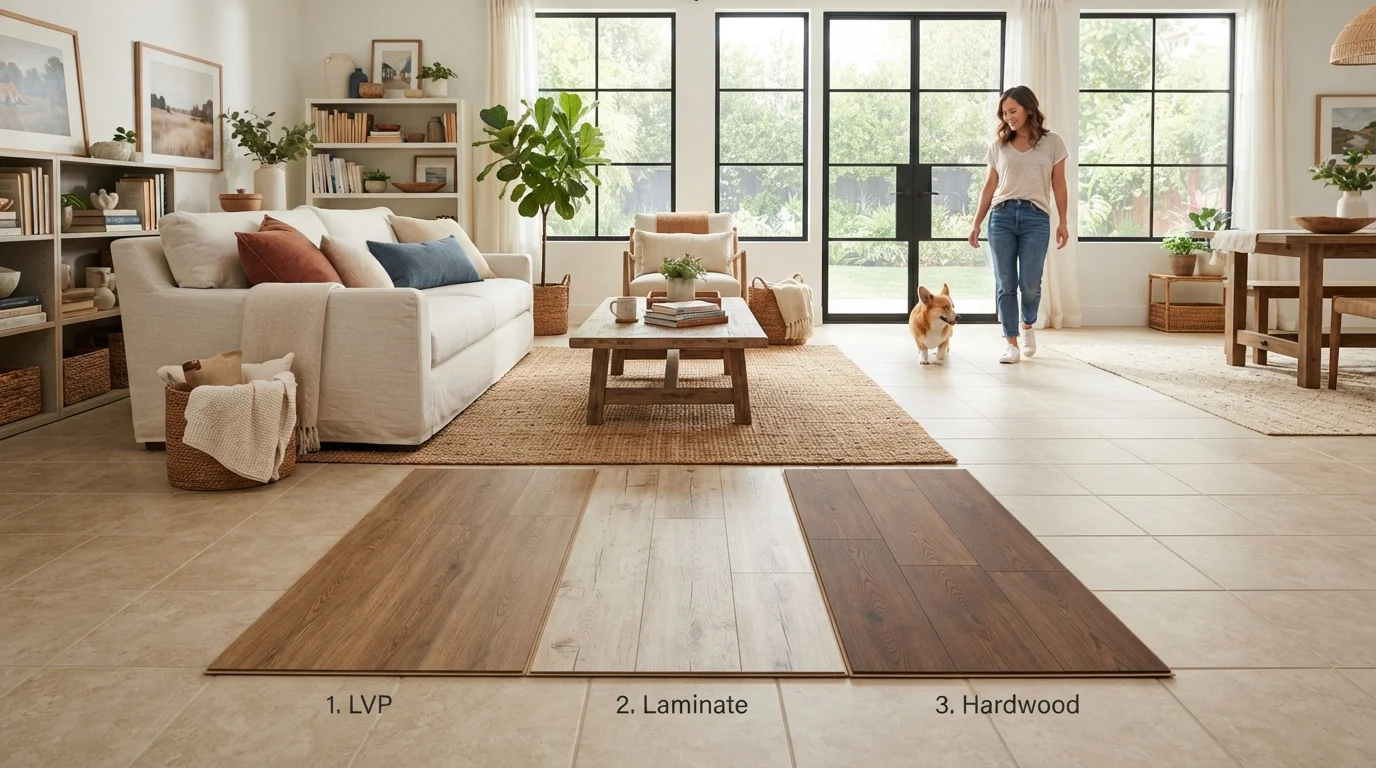
Key Takeaways
- Vinyl plank handles moisture well and costs less upfront, making it practical for bathrooms, kitchens, and basements.
- Laminate offers a wood look at a moderate price but is vulnerable to water damage and cannot be refinished.
- Solid hardwood costs the most upfront but can be sanded and refinished multiple times, extending its lifespan significantly.
- DIY installation is realistic for vinyl and laminate; hardwood often benefits from professional installation.
- Local permit requirements rarely apply to flooring replacement, but structural subfloor repairs may need a licensed contractor.
Our Verdict
No single flooring type wins across every room or budget. Vinyl plank suits high-moisture or high-traffic zones where waterproofing matters most. Laminate fits dry living areas where families want a wood appearance without hardwood pricing. Solid hardwood makes sense when long-term property value and refinishability outweigh a higher initial cost.
| Best for | Recommended |
|---|---|
| Kitchens, bathrooms, and basements with moisture exposure | Vinyl plank |
| Dry living or dining rooms on a moderate budget | Laminate |
| Homeowners prioritizing longevity and refinishability | Solid hardwood |
| DIY-first families wanting the fastest installation | Vinyl plank or laminate (click-lock) |
What separates these three materials
Vinyl plank, laminate, and hardwood differ at the material level, and those differences drive almost every trade-off families face. Vinyl plank (often called luxury vinyl plank, or LVP) is a synthetic product built from polyvinyl chloride with a photographic wear layer on top. Laminate is a wood composite core with a photographic image layer bonded to it. Solid hardwood is milled from a single piece of timber. Engineered hardwood, a related option, uses a real wood veneer over a plywood core, though this article focuses on the three most commonly compared types.
The construction of each material determines how it responds to water, foot traffic, pets, and temperature swings, which are exactly the conditions a family home produces every day. Understanding the material is the first step before comparing costs or installation methods.
For a broader look at how upfront costs compare to long-term ownership expenses across major household decisions, see the financial trade-offs families often overlook when thinking about housing costs overall.
Cost comparison: upfront and long-term
Material prices shift with supply chains, but the general tiers have been consistent for several years. Vinyl plank typically runs $2 to $5 per square foot for the material. Laminate falls in a similar range, often $1.50 to $4 per square foot. Solid hardwood ranges from $5 to $12 or more per square foot depending on species, grade, and width.
Installation labor adds $1.50 to $4 per square foot for professional work on vinyl and laminate. Hardwood installation, which often requires nailing or stapling into a wood subfloor, typically adds $3 to $6 per square foot.
The long-term picture changes things. Solid hardwood can be sanded and refinished three to five times over its life, with each refinish costing roughly $3 to $5 per square foot. That means a hardwood floor installed once can serve a home for 50 years or more. Vinyl and laminate cannot be refinished; once the wear layer or surface degrades, the floor must be replaced. Laminate is also more vulnerable to moisture damage, which can shorten its life in high-humidity homes.
| Vinyl plank | Laminate | Solid hardwood | |
|---|---|---|---|
| Typical material cost (per sq ft) | $2 to $5 | $1.50 to $4 | $5 to $12+ |
| Waterproof | Yes (most products) | No | No |
| DIY installation difficulty | Low | Low | Moderate to high |
| Can be refinished | No | No | Yes (multiple times) |
| Expected lifespan | 15 to 25 years | 10 to 20 years | 50+ years with care |
| Pet and scratch resistance | Good (wear layer dependent) | Moderate | Species dependent |
| Suitable for basements | Yes | No | Generally no |
Families thinking carefully about total cost of ownership across large purchases will recognize this pattern. What families actually pay beyond the sticker price applies just as much to floors as it does to vehicles.
Durability and family life
Vinyl plank is waterproof at the surface and, in most products, through the core. It resists pet accidents, spilled drinks, and bathroom humidity without swelling. The wear layer ranges from 6 mil (thinner residential grades) to 20 mil or more (commercial-grade), and that thickness directly determines scratch resistance. Pets and heavy furniture move wear layer faster on thinner products.
Laminate absorbs moisture at the edges and seams if liquid sits on it for more than a short period. A spilled cup of water wiped up immediately is usually fine. A slow leak behind a dishwasher is not. Swelling and delamination are the common failure modes, and they are not repairable.
Solid hardwood dents and scratches, and it expands and contracts with seasonal humidity changes. Gaps may appear in winter and close in summer. This is normal behavior, not a defect. Harder wood species, measured on the Janka hardness scale, resist denting better. White oak and hickory, for example, are harder than pine or cherry.
DIY installation: what each material demands
Both vinyl plank and laminate are available in click-lock floating formats, meaning the planks attach to each other rather than to the subfloor. A homeowner with basic tools, patience, and a flat, clean subfloor can complete either installation over a weekend for an average room. Neither requires adhesive in most residential applications, though glue-down vinyl is used in some settings.
Solid hardwood requires a clean, dry, structurally sound wood subfloor (not concrete, in most cases). Installation involves nailing or stapling each plank down, which requires a flooring nailer and some physical effort. Gaps at walls must be controlled, and the wood typically needs to acclimate in the home for several days before installation begins. This is manageable for a confident DIYer, but the margin for error is smaller than with floating floors.
Acclimate your materials before installation
Solid hardwood needs 3 to 5 days inside the home before installation so it adjusts to the room's temperature and humidity. Skipping this step can cause gaps or buckling later. Laminate and vinyl plank also benefit from 24 to 48 hours of acclimation, especially in climates with extreme temperature swings. Store planks flat and away from exterior walls during this period.
Regardless of material, check the subfloor condition before ordering flooring. Soft spots, squeaks, or height variation greater than 3/16 inch over 10 feet can cause failures in any flooring type. Subfloor repair involving structural elements may require a licensed contractor depending on local codes.
Flooring choices are similar in structure to the paint-or-panels decision: the right answer depends on moisture, traffic, and how long you plan to stay in the home.
Which rooms favor which material
Moisture is the main room-level variable. Vinyl plank is the practical choice for bathrooms, laundry rooms, kitchens, and below-grade spaces. Laminate should generally stay in dry areas, living rooms, bedrooms, and hallways that do not see regular liquid exposure. Hardwood works well in living rooms, dining rooms, and bedrooms but is not recommended for full bathrooms or basements with humidity problems.
Traffic patterns matter too. A main hallway that sees muddy boots and heavy foot traffic will wear a thin vinyl wear layer faster than a bedroom. Matching the wear layer rating to the room's actual use, rather than choosing by appearance alone, will extend the floor's life.
Budget-minded families can also mix materials across zones without the result looking disjointed. Vinyl in wet areas, laminate in secondary bedrooms, and hardwood in main living spaces is a common and cost-effective approach. For more strategies on allocating home budgets wisely, frugal family living resources cover a range of household spending decisions.