
Minivan vs. Three-Row SUV: A Practical Look at Space, Safety, and Running Costs

Key Takeaways
- Minivans generally cost less to buy and operate than comparably sized three-row SUVs.
- Sliding rear doors and a lower floor make minivans significantly easier for child passengers to board.
- Three-row SUVs typically offer better towing capacity and available all-wheel drive.
- Cargo space behind the third row is often larger in minivans despite their smaller exterior footprint.
- Safety ratings for both body styles have improved, but specific trim levels still vary widely.
Our Verdict
Minivans deliver more interior space, lower running costs, and easier passenger access at a lower purchase price for most families. Three-row SUVs make more sense when towing, off-road capability, or all-wheel drive traction are genuine priorities rather than marketing appeal.
| Best for | Recommended |
|---|---|
| Families prioritizing day-to-day practicality and lower costs | Minivan |
| Households that regularly tow a trailer or boat | Three-row SUV |
| Drivers in snowy or rural regions needing all-wheel drive | Three-row SUV |
| Large families doing frequent road trips with lots of luggage | Minivan |
How the two body styles actually differ
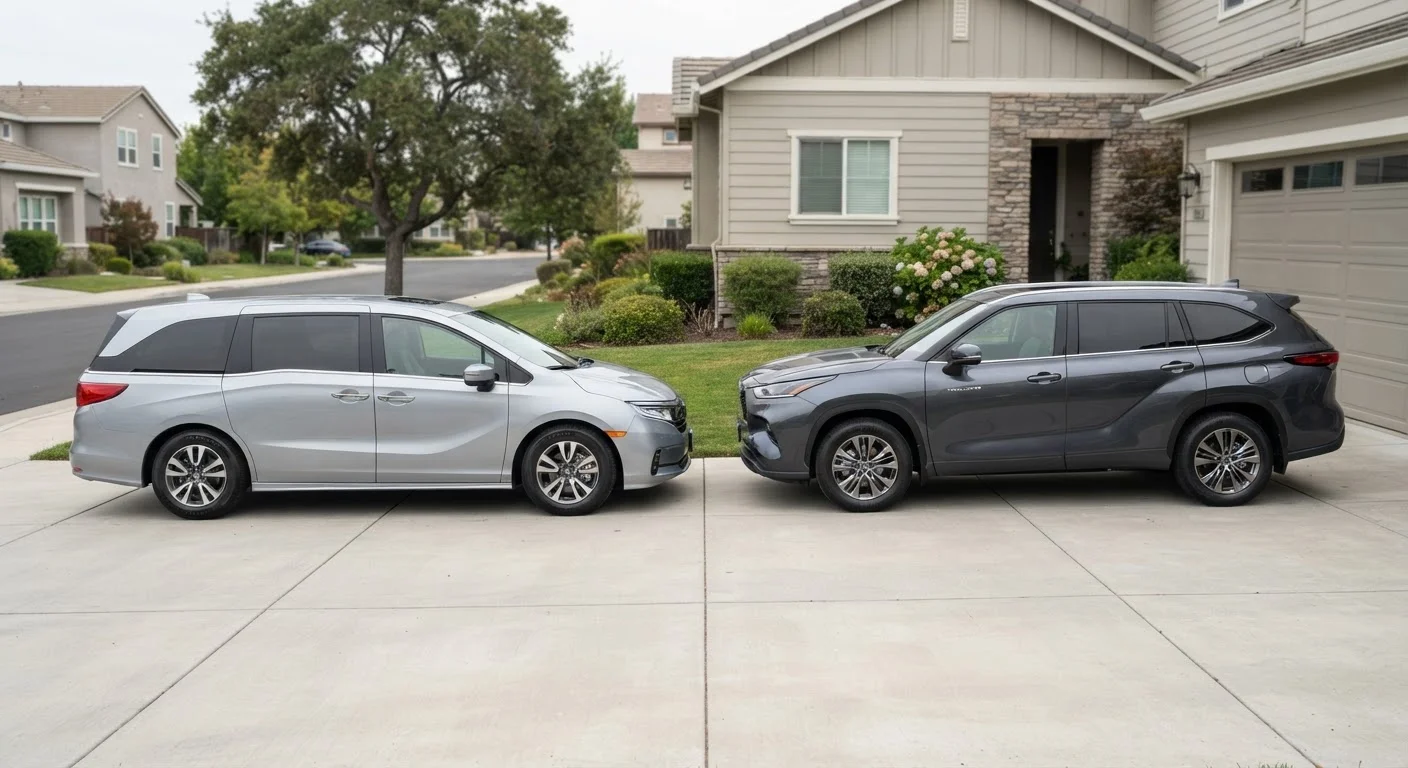
A minivan and a three-row SUV can carry the same headcount, yet they are built around different priorities. A minivan uses a dedicated, purpose-built platform with a low, flat floor, a tall cabin, and sliding rear doors. A three-row SUV stretches a truck- or car-based platform to squeeze in a third row, which often means a raised step-in height and a compromised rearmost seat.
That structural difference shows up in ways families feel every day: how easy it is for a six-year-old to climb in, whether the third row is actually comfortable for adults, and how much luggage fits behind the last seat. Before comparing prices or fuel economy, it helps to understand that these vehicles solve the same seating problem with genuinely different engineering approaches. For a broader look at how to frame this decision within a total budget, see our ground-up family car buying overview.
Interior space and passenger comfort
Minivans win on usable interior volume almost every time. The flat floor means second- and third-row passengers have unobstructed foot space, and the high roofline gives adults room to sit upright in row three. Sliding doors eliminate the swing arc needed for hinged SUV doors, which matters in tight parking lots and garage bays.
Three-row SUV third rows are a mixed picture. Mid-size models often seat children comfortably back there, but adults on longer trips tend to find the space cramped. Full-size SUVs do better, but they come with a substantial price premium and worse fuel economy. The step-in height on most three-row SUVs requires toddlers and older passengers to climb rather than step in.
Cargo behind the third row is another area where minivans hold an advantage. Many minivans provide around 30 to 35 cubic feet of cargo space with all rows up, while mid-size three-row SUVs typically offer 15 to 20 cubic feet in the same configuration. Fold or remove the seats in a minivan and total cargo volume can approach that of a full-size van.
| Minivan | Three-Row SUV (mid-size) | Three-Row SUV (full-size) | |
|---|---|---|---|
| Typical starting price (new) | $35,000 - $40,000 | $40,000 - $50,000 | $55,000 - $75,000+ |
| EPA combined fuel economy | Mid-20s mpg (FWD) | Upper teens - low 20s mpg | Low-to-mid teens mpg |
| Third-row adult comfort | Comfortable, full headroom | Tight for most adults | Adequate to comfortable |
| Cargo behind third row | 30-35 cu ft (approx.) | 15-20 cu ft (approx.) | 20-25 cu ft (approx.) |
| All-wheel drive availability | Limited or unavailable | Standard on many trims | Standard on most trims |
| Typical tow rating | 3,500 - 3,600 lbs | 5,000 - 6,000 lbs | 7,500 - 8,500 lbs |
| Ease of child boarding | High (sliding doors, low floor) | Moderate (raised step-in) | Low (high step-in) |
| Parking and maneuverability | Manageable despite length | Moderate difficulty | Challenging in tight spaces |
Fuel economy and running costs
Fuel economy is one of the clearest financial arguments for a minivan. Most front-wheel-drive minivans return fuel economy in the mid-20s (miles per gallon combined) under EPA estimates. Three-row SUVs with all-wheel drive commonly land in the upper teens to low-20s combined, depending on engine and drivetrain.
Over 15,000 miles per year, that difference can add up to several hundred dollars annually at typical gas prices, though the exact amount depends on your local fuel costs and driving mix. Add in the fact that minivans generally carry a lower sticker price than a comparably equipped three-row SUV, and the cost gap over a five-year ownership period can be meaningful. Our total cost of ownership breakdown walks through how fuel, insurance, and depreciation compound over time.
Insurance costs tend to be lower for minivans as well, partly because their drivers have a lower average claim rate in actuarial data and partly because replacement parts are less expensive than those for truck-based SUVs.
Check the full cost picture before deciding
Purchase price is one line item. Factor in expected fuel costs over three to five years, insurance quotes for each specific model you are considering, and the availability of affordable replacement parts. A vehicle with a $5,000 lower sticker price can still cost more over time if it gets significantly worse fuel economy or commands higher insurance premiums. Request quotes from your insurer for any model before committing.
Safety ratings and family-relevant features
Both body styles have earned strong safety results in government and independent crash testing, but the results vary by specific model and trim level. Families should look up ratings for the exact vehicle they are considering rather than assuming a body style is uniformly safe. The Insurance Institute for Highway Safety (IIHS) and the National Highway Traffic Safety Administration (NHTSA) publish model-level data that is free to access.
Modern automatic emergency braking, lane-keeping assist, and blind-spot monitoring are available on both minivans and three-row SUVs, though these features may only be standard on higher trims. On a tight budget, it is worth checking whether the trim level you can afford includes the safety technology you want, or whether it costs extra. Our guide to safety features worth prioritizing covers which systems have the strongest evidence of reducing injury risk for young passengers.
One structural note: minivans generally have a lower center of gravity than body-on-frame three-row SUVs, which reduces rollover risk, though modern electronic stability control has narrowed this gap considerably across the market.
Where three-row SUVs have a real edge
If towing is a genuine requirement, a three-row SUV is the practical answer. Most minivans are rated to tow between 3,500 and 3,600 pounds, which covers a small camper or a boat under 20 feet. Mid-size three-row SUVs often handle 5,000 to 6,000 pounds, and full-size models can go higher. If you own or plan to buy a larger trailer, a minivan will not meet that need.
All-wheel drive is the other meaningful differentiator. Most minivans are front-wheel drive, with limited AWD availability, while three-row SUVs offer AWD across most of the segment. For families in mountain regions or states with heavy winter snowfall, AWD combined with proper winter tires provides a real safety margin. Front-wheel-drive minivans with winter tires perform well in snow, but AWD gives additional confidence on steep grades and ice.
Families considering a used vehicle in either category should read our used vehicle pre-purchase inspection guide before committing, since drivetrain condition and towing history are among the items worth verifying in person.
Making the call for your family
The right choice depends on how you actually use a vehicle most days, not the occasional scenario. If the third row sees weekly use, kids are boarding and exiting multiple times daily, and budget is a constraint, the minivan's lower cost and easier access are hard arguments to set aside. If towing a trailer several times a year or driving in conditions where AWD is genuinely useful, a three-row SUV addresses those needs more directly.
Families who find the minivan's practicality appealing but are not ready to buy new should look at the certified pre-owned market, where late-model minivans can offer significant savings. Our CPO vs. used comparison explains how to weigh program protections against the price difference.
This article provides general educational information about vehicle categories. It is not financial, mechanical, or safety advice tailored to your specific situation. Consult a qualified mechanic before purchasing any used vehicle and verify current pricing, ratings, and specifications directly with manufacturers and independent testing organizations.