
Renting vs. Owning Everyday Items: What Makes Financial Sense for Families

Key Takeaways
- Frequency of use is the single most reliable test for whether buying beats renting financially.
- Storage costs, maintenance, and depreciation are real ownership expenses families often undercount.
- Renting cuts total outlay for one-time events like parties and seasonal projects.
- Baby and toddler gear has a short use window, making rental or borrowing worth evaluating first.
- The break-even point varies by category; running the numbers for each item type is worth the time.
Option A
Renting
The pay-per-use approach for occasional needs.
Best for: Items used rarely, one-time events, or gear that quickly becomes outgrown or obsolete.
Option B
Owning
The long-term investment for regular, recurring use.
Best for: Items used frequently enough that per-use cost drops well below any rental fee over time.
If you need a tool or piece of equipment for a single project
Renting
One-time rental fees are almost always lower than the purchase price plus storage and maintenance costs for an item used once or twice a year.
If you use an item weekly or more often
Owning
High-frequency use brings the per-use cost of ownership down fast, and the convenience of having it on hand has real practical value.
If you are outfitting a first birthday party or seasonal event
Renting
Party supplies, inflatables, and decorations sit unused for months between events; renting avoids storage clutter and upfront cost.
If you have an infant or toddler at home
Renting
Baby gear is used for a narrow age window, and rental or borrowing programs can cover that window without the full purchase price.
If you run a household with ongoing maintenance needs
Owning
Lawnmowers, basic hand tools, and cleaning equipment used regularly pay for themselves within a few seasons of consistent use.
The core question: how often will you actually use it?
Before any purchase, one question cuts through the noise: how many times in the next 12 months will this item be used? If the honest answer is fewer than five or six times, the math usually favors renting. If it is weekly or near-weekly, ownership typically wins on cost over a short horizon.
This is not a new idea, but families rarely apply it systematically. A pressure washer used twice a year costs more to own (purchase, storage, occasional maintenance) than the combined rental fee for those two sessions. A slow cooker used every other week pays for itself within months. The frequency threshold differs by category, but the logic is the same across all of them.
For a fuller picture of what ownership really costs beyond the purchase price, see the total cost of ownership breakdown which, while written around vehicles, lays out a framework applicable to any durable item.
| Criterion | Renting | Owning |
|---|---|---|
| Upfront cost | Low (daily or weekend fee) | High (full purchase price) |
| Best use frequency | Rarely (fewer than 5-6x/year) | Regularly (weekly or more) |
| Storage required | None | Dedicated shelf or space |
| Maintenance responsibility | Handled by rental provider | Falls on the owner |
| Availability | Must plan and travel to pick up | On hand immediately |
| Long-term cost (high frequency) | Fees accumulate over time | Cost per use drops steadily |
| Risk of obsolescence | None (return and upgrade) | Item may become outdated |
Categories where renting consistently saves money
Certain item categories almost always favor renting for family households.
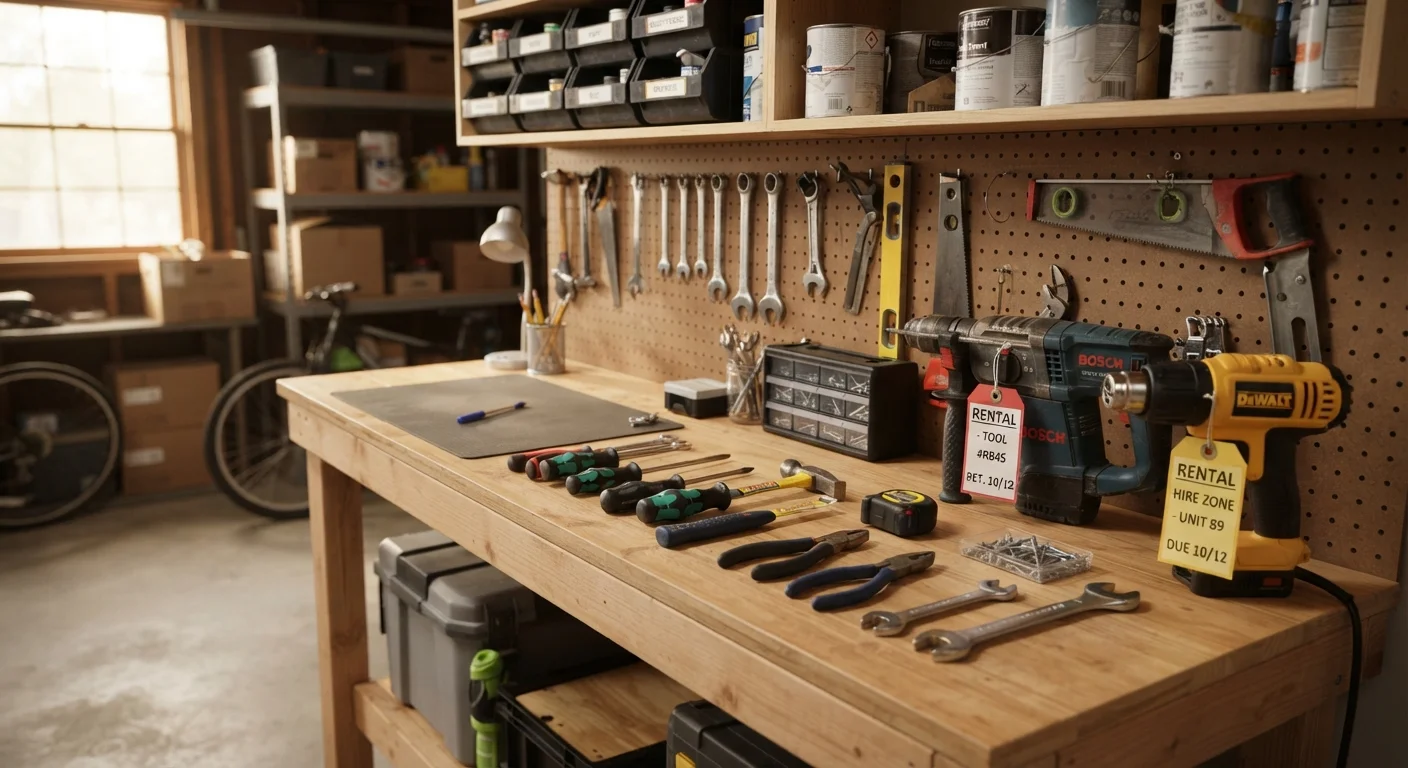
Power tools and specialty equipment. Tile saws, concrete mixers, carpet cleaners, and pressure washers cost hundreds of dollars to buy and may sit unused for months after a single project. Rental outlets charge by the day or weekend. Even if you tackle two or three projects a year, rental fees rarely exceed the purchase price across several years of occasional use, once storage and wear are counted.
Party and event supplies fall into the same category. Tables, chairs, canopies, and inflatables have a narrow use window per year and take up significant storage space. Building irregular expenses like parties into a household budget is easier when you treat them as a predictable rental line item rather than a lumpy capital purchase.
Baby and toddler gear is its own case. Swings, bouncers, high chairs, and infant carriers have a use window of months, not years. Some families borrow; others use rental programs through local parent groups or national services. Either path can avoid the full sticker price for equipment used briefly before a child outgrows it.
Categories where owning wins over time
Frequent use is the clearest signal that ownership makes financial sense. Basic hand tools (hammers, screwdrivers, a cordless drill) are used often enough in most households that buying once and maintaining lightly is far cheaper than renting on an ad hoc basis. The same holds for lawnmowers and garden hoses in households with yards, and kitchen appliances used multiple times per week.
Ownership also makes sense when availability matters. Renting requires planning ahead, traveling to pick up, and returning on time. For items needed spontaneously or urgently, the convenience premium of ownership is real and worth pricing in. Involving kids in these trade-off conversations can also turn routine purchase decisions into practical financial literacy lessons.
The hidden ownership costs to count honestly are storage space, periodic maintenance, and the replacement cost when something wears out. Items that are cheap to store, require no servicing, and last years with normal use are strong ownership candidates. Items that need a dedicated shelf, annual servicing, or degrade quickly shift the balance back toward renting.
~$600
Average US household annual tool and equipment spend
U.S. Bureau of Labor Statistics Consumer Expenditure data shows households regularly spend on household equipment that may be used infrequently.
2-3 years
Typical usable window for infant and toddler gear
Pediatric development guidelines note most infant-specific equipment is outgrown well before a child's third birthday, limiting ownership value.
30-50%
Portion of purchased tools used fewer than 5 times
Consumer research from the tool rental industry has consistently found a large share of household tool purchases are used only a handful of times before being stored indefinitely.
Running a quick break-even estimate
A simple calculation helps: divide the total purchase price (including any annual maintenance cost) by the per-use rental fee. That gives you the number of uses at which owning becomes cheaper than renting. If you will realistically hit that number within two or three years, buying is defensible. If it would take a decade of use to break even, renting is the cleaner financial choice.
For example, a carpet cleaner priced at $300 with a typical rental fee of $40 per day breaks even at 7.5 uses. If your household needs it twice a year, that is nearly four years to break even, not counting storage or any repair costs. At twice that frequency, the math shifts.
This framework applies beyond household goods. The rent-vs-own analysis for housing uses the same underlying logic at a much larger scale. Families who get comfortable running these estimates for small items are better prepared for bigger financial decisions. This article is for general informational purposes and does not constitute financial advice; consider consulting a qualified financial professional for decisions specific to your household.